


Apple’s first WWDC was in 1983, and it’s been running annually since 1989. Is there a mobile engineer out there who has been to all 41 events? Is there even an Apple employee who has been to all 41? This question is impossible to answer, or at least is impossible to answer using ChatGPT or Google while sitting at a desk writing a newsletter. So let’s ask another question: Did you know Bill Gates was at the very first WWDC? During an on-stage gameshow skit about dating the Macintosh (yes, this is real), he said that he “expected half of Microsoft’s 1984 revenue to come from Macintosh.” The crowd went wild. Steve Jobs smiled. The early 80s were truly a very different time.
Whether you’ve somehow managed to attend every WWDC ever and were there live in 1983 as three tech CEOs described their experiences “dating” Macintosh, or are an Android developer wondering when this month’s newsletter is going to move on to more Google-focused topics, the Flight Deck will be here, considering why AI progress creates more work for humans instead of less, detailing how to tackle incremental maintenance of Android codebases, and sharing inside looks at how to use the Runway MCP.
Posts we liked
Incremental maintenance of Android codebases
Look at that — the wait for a Google topic in this month’s newsletter is officially over. Android is now 17 years old, which means there are many Android codebases out there that are at least close to 17 years old too. When you update a core feature of such an app, even for something as simple as a navigation item that’s been around from the early days, you’ll have to touch some code that looks like it might fall over if you breathe on it too hard. Ryan Harter considers how you can use this time to update and modernize this rickety code without it turning into a huge thing.
Why AI progress creates more work for humans, not less
An increasingly common theme this year is that AI is useful and changes the way everyone works, but it does not 10x (or 100x, as some companies claim when they use AI as an excuse for layoffs) the output of individual employees. It instead replaces some work and speeds up other types of work, while requiring human attention to ensure all this work is actually useful and functional. Dan Shipper explores why, in an era when every human appears to need an agent, every agent needs a human.
Trust, then verify when developing for iOS with Claude
Anthropic’s own best practices say that if you want good code from Claude, you need to provide it with “a way to verify its work.” That way, you can take the time to manually review every line of code it writes and act as its only feedback loop, which is a good way to go insane with stress, or you can add skills like ios-build-verify to help take some of this verification load off of you and your colleagues. Josh Adams dives into everything he used to have to do to verify his Claude-generated code and why it led him to build this skill.
When everyone ships code, who owns production?
Everyone’s a builder now. PMs are builders. Execs are builders. Even marketers are builders. Building stuff is great. But building is only a part of what goes into creating an app and a business. As PR volume increases at a rapid rate, PR sizes increase at an even more rapid rate, and teams are rewarded for velocity above all else, Dunka Kirkali considers who actually has to take ownership of what comes out of all of this building and ensures it works in a coherent, cohesive way without (too many) incidents.
The buffer we accidentally deleted
Until such a time that we achieve AGI and we’re all spending our days in floating Wall-E barcaloungers watching Mr. Beast Jr’s videos, we humans will need ‘buffer time’ — to think about the software projects we build, beyond just writing the code and shipping it to production. Phil Boyd argues that we’ve lost that buffer and essentially overclocked the development process, leaving little time to actually stop and think about the things that can’t be rushed.
On-demand mobile releases: How UpKeep got there and why you should too
Does your mobile engineering team run a release rotation that finds a different engineer throwing away a day of their coding work to manually run your releases every two weeks? Do they follow a 25-step Confluence checklist that must be done in exact order to ensure the whole release doesn’t fall apart? If you use Runway, you don’t, but if you run your releases like UpKeep used to, you do. Alex Bush walks through how they got to easy, on-demand releases and what this new freedom allowed them to do.
Go figure
If you run a mobile engineering team, your build pipeline probably isn't the time sink it used to be. That friction has moved into the layer around it: who runs the broader release process, how status gets communicated across teams and up to leadership, how AI-touched code clears review, and how you’ll be wielding your capacity in the next quarter.
83% of mobile EMs say fixing release management would accelerate their roadmap.
The decisions with the most leverage heading into the next budget cycle aren't engineering ones — they're about visibility, ownership, leadership perception, AI policy, and where the next dollar goes.
Download our new 2026 guide to Mobile Release Management for EMs. It gets into each of these decisions, grounded in our survey of 300 mobile EMs' Q1 2026 responses and in what we've learned working with hundreds of mobile teams.
Posts we wrote and live panels we're hosting
AI assistants are getting better at mobile development. They still can't tell you the status of your current release. The Runway MCP gives your AI assistant the release context it's been missing, allowing it to see what's shipping, what's stuck, and what's about to change, instead of having to guess. In this session, we will walk through it end-to-end: how to connect the Runway MCP in under two minutes, real release scenarios where it makes a difference, what's coming next, and live Q&A.
How much time do mobile engineers really lose per release?
Where does all the time go? If you spend any time managing your team’s mobile releases, you know quite a bit of it goes wrangles lots of people and completing lots of manual steps to get it over the finish line. But just how much time are mobile engineers actually losing to what can often feel like administrative busy work? Quite a lot as it turns out. Get in-depth detail in our article.
Runway featured feature
It can be hard to keep tabs on binary size from release to release, and even small increases can affect download and install metrics. That’s why Runway has a notification that monitors build size and alerts you if build size increases beyond some configurable threshold compared to your previous release.
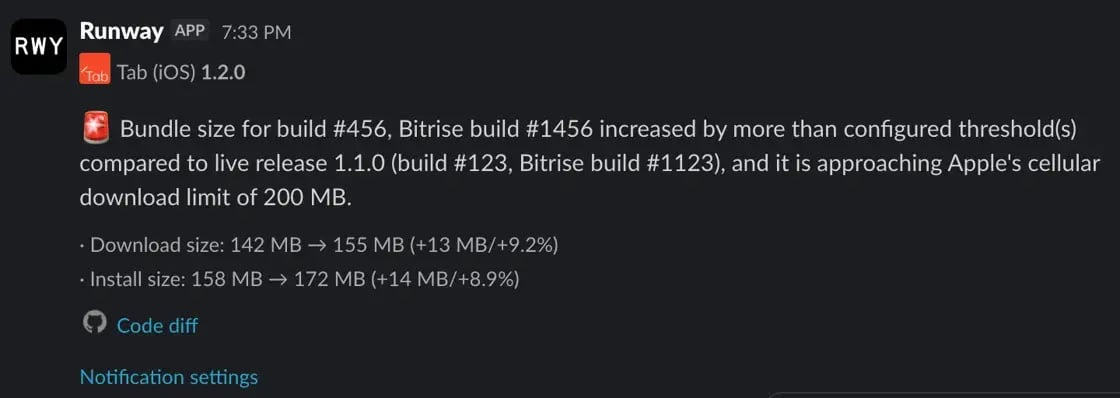
You can adjust the threshold as a percentage or an absolute delta, and choose to be alerted for all builds that exceed the configured threshold or only the first build in a release that does so.
You can also choose to monitor download size (Android and iOS), install size (iOS only), or both (iOS). On the iOS side, you can choose a specific device model to monitor if your team prefers that to Universal, and you can also configure an additional alert that fires if your bundle is approaching Apple’s 200 MB cellular download limit.
Events
WWDC is next week, which means the third annual Runway Apple Park Happy Hour at the Duke of Edinburgh is on Saturday. That’s tomorrow!
If you’re not going to be at WWDC, we have many more events and conferences to come. In the meantime, you can read about our previous events from the last 32 installments of the Flight Deck.


