


A big topic at WWDC last month was Siri AI, a huge update that puts Siri right on the verge of being genuinely (ha) very useful. Before this announcement, a typical Siri interaction might entail saying “Siri, call Rebecca!” via CarPlay three times while driving and having her reply, “Sorry, I didn’t get that,” the first time and then “calling Chewbacca,” the second time (which is what you get for putting Chewbacca in as a contact in your phone as a joke) before finally actually “calling Rebecca” the third time. When Apple’s own press release says they’re introducing a “profoundly more capable assistant,” I think it’s fair to say Siri has been dealing with some image problems.
Whether you’re excited about all the future conversations you’re going to have with Apple Intelligence Siri, or you don’t care about all that because you’re using Gemini on Android, the Flight Deck will be here to share a complete guide to alternative billing with Google Play’s Billing Choice, take you inside the Q&A from WWDC26’s Swift Group Lab, explain why “understanding” is the new bottleneck, and look at how Fleetio saves hundreds of developer hours using Runway.
Posts we liked
As noted above, Siri is getting a nice update with iOS 27, and part of this will enable your app users to interact and take actions via Siri instead of your own UI. How you provide Siri with awareness of, and access to, your app hasn’t changed much; it’s still about app entities, schemas, and a few APIs, but that doesn’t mean there’s nothing new you need to do. Jordan Morgan explores just how easily you can make sure your app fully takes advantage of Siri’s new abilities.
Forget the tech debt your team may already be dealing with; you now have to worry about prompt debt. Natural language models are great, but pairing them with probabilistic language models means that different words in different situations can yield different outcomes, even when the prompts are written by the same software engineer. Daniel Breunig takes a deep dive into how you can minimize this new form of technical debt without just going back to building tech debt by hand-coding every line yourself.
Just because we can build it, should we?
AI has made it increasingly possible for platform engineering teams to build almost anything they need from scratch. An ambitious engineer can look around at the expensive SaaS tools their company is pumping money into and say, “I could build that,” and then actually stand up their own simplified version of it in a week. But should they? Building tooling is very, very different from owning and operating that tooling forever. Rick Fast discusses his approach as the SVP of Platform Engineering at Expedia.
From dashboards to decisions, how improving one outcome changed four
Engineers famously love meetings. There’s nothing like taking the opportunity to gather together five times a day to say “nothing from my end” while a manager attempts to fill the time with the appearance of productivity so the meeting feels worth it. But what would happen if developer focus time was purposely increased and required to hit a specific, high number of hours? Brian Houck discusses doing exactly this in Microsoft’s CoreAI organization, which led to productivity gains that equaled the output of hiring 350 new developers. And he gets into other topics too.
Understanding is the new bottleneck
Let’s say you’ve perfected your prompting to such a degree that you have no prompt debt and your coding agent is turning out code so clean that it generates little to no tech debt on its own (that’s likely not happening, but let’s still say it is). You still face another potential problem: cognitive debt. You need to understand the code your agent is turning out, not just so you can verify it works, but so that you can actually participate in building your app; otherwise, you won’t be able to come up with the next ideas to evolve it. Geoffrey Litt details his own Techniques for Understanding.
Lots and lots of very good questions are asked at WWDC. You could watch (or rewatch) the recordings, or you could read Anton Gubarenko’s transcript, which includes the many great questions from attendees alongside the excellent, detailed answers from Apple engineers. His goal, as he says, is simple: to make the questions easier to scan, to revisit, and to connect with real app development problems. Each answer includes a time-code link so you can watch the video answer for more context. This is just one post in a larger series from Anton covering several different sessions.
Go figure
Who runs releases for mobile teams in 2026?
According to the 300 EMs we surveyed for our newest State of Mobile Release Management report, its senior mobile engineers nearly half of the time.
The problem is, when those senior engineers run releases, only 9% of them complete more than three-quarters of their planned sprint work that cycle. And 44% of them complete less than half.
Download our new 2026 guide to Mobile Release Management for EMs and get all the details on the above and many other issues facing modern mobile teams.
Posts we wrote and live panels we're hosting
Lessons from Monzo, Spotify, Etsy, and Tuist on build vs. buy for mobile release tooling
Should you build or buy when it comes to mobile release tooling? This blog post shares the firsthand experiences of Maria Neumayer from Monzo, Jacob Vesterlund from Spotify, Jay Henry from Etsy, and Pedro Piñera from Tuist. It details how they evaluated their decisions, what the real costs look like, how to know when what you've built is no longer working, and how AI changes the calculus. It also links to a recording of a larger discussion the four of them had with us on the topic.
How Fleetio recovered hundreds of developer hours with Runway
Fleetio runs a six-person release captain rotation per platform, which means any given engineer only cuts a release every six weeks. That's a lot of time to forget how things work and many hours spent running through manual checklists to get up to speed. Or at least it was a lot of time before Fleetio began using Runway. Releases used to take two to four hours for an experienced engineer, and longer if something went wrong. Now, cutting a release takes five minutes, and shepherding it along the way takes a few more. Find out how Runway helped Fleetio do this.
No matter how good AI assistants get at development, they still can't tell you the status of your current release. Runway MCP gives your AI assistant the release context it's been missing, letting it see what's shipping, what's stuck, and what's about to change. Join us on July 16th to learn how to connect the Runway MCP in under two minutes, hear real release scenarios where it makes a difference, learn what's coming next, and ask questions live.
Runway featured feature
Did you know you can customize your Org overview dashboard by rearranging and resizing charts and selecting exactly which metrics you want to surface? And there are many types of filters that allow you to drill down by apps, platforms, teams, and team members where applicable.
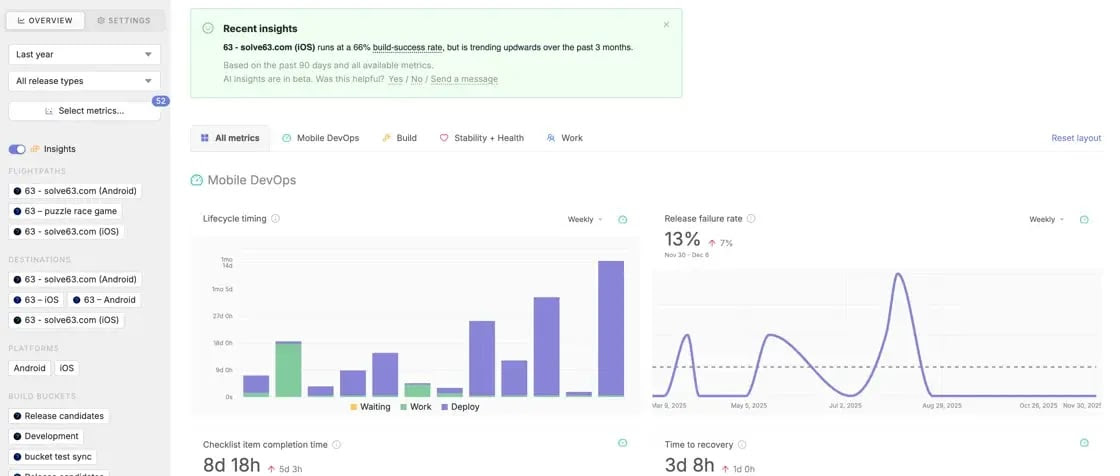
Customize charts like these:
- Checklist, approval, and regression item completion rates (How often is your team actioning requisite tasks in your process? How often are test cases passing?)
- Target date hit rates (Do you tend to kick off, submit, and release on time? Where do delays tend to crop up?)
- Cherry-pick volume and acceptance rate for late fixes (How many changes does your team add post-cut? How often are late changes pushed back on?)
- Any or all of the stability and health metrics you have configured for rollout monitoring (How are key health metrics tracking over multiple releases? What baselines should inform your alerting and automation thresholds?)
To help you make sense of all this data, we surface benchmarks sourced from comparable teams and summarize key changes and trends in AI-powered insights at the top of the page, which link directly to the specific charts they concern.
Events
WWDC is over. But our Summer of Events has only just started. It’s like the Summer of Love, but for attending mobile development talks and having a beer or soda after, instead of grooving out to cool music in Golden Gate Park in 1967.
Where will you find us?
- droidCon USA in Orlando, July 16 to 17
- Swift Rockies in Calgary, July 22 to 23
- Chain React in Portland, July 30 to 31
If you’re visiting North America because you bought tickets thinking your team would be in the World Cup final, stick around and stop by our booth at one of these conferences.
If you’re unable to attend any of the above, you can try to recreate the experience of hearing us talk by reading some of our previous 33 installments of the Flight Deck.


