TL;DR: You can boost visibility and coordination in your mobile release process by:
- Creating a single source of truth for release status.
- Defining clear ownership at each stage.
- Automating routine handoffs and notifications.
- Adding health metrics for everyone on the team to see.
The biggest lever is moving from scattered, tribal-knowledge-driven releases to a structured workflow. This way, every stakeholder—engineering, QA, product, and leadership—can see exactly where things stand without needing to ask.
That sounds obvious. So why is it so hard to actually get there?
Unfortunately, most teams just accept poor visibility and friction-filled coordination as the cost of doing mobile business. Our 2025 State of Mobile Release Management Report shows that over half of teams, 51%, see their release management processes as "somewhat efficient."" Not broken. Not painful. Just... fine.
But “fine” is doing a lot of heavy lifting here. Those same teams spend nearly a third of every release cycle on manual tasks and administrative busywork that doesn't directly contribute to user value. For teams on a biweekly cadence, that's an average of five hours per release, adding up to 130 hours (or roughly three full work weeks) of engineering time per year. consumed by coordination overhead, status chasing, and repetitive mechanical work.
Mobile teams have stopped noticing the inefficiency. Senior engineering managers responsible for shipping velocity and DevEx often lack clear visibility into this black box. As a result, they struggle to diagnose problems or effectively advocate for necessary fixes, which compound into major headaches as mobile orgs mature and scale.
This post breaks down how you can support real visibility for everyone, from C-suite executives to individual mobile engineers. Which means you can concentrate on product strategy instead of constantly firefighting.
Start with a single source of truth for release status
Fragmented information is the number one visibility killer in mobile releases. When a release's status is spread across Jira tickets, Slack threads, and spreadsheets, no one sees the whole picture.
The concept of a "single source of truth" gets thrown around a lot. Here’s what we really mean for mobile releases: a centralized, always-current view of where every release stands. This covers what's in the build, what's blocking progress, who's responsible for each stage, and what the timeline looks like. It should live in one unified place that’s accessible to everyone on the team who needs it.
Our data shows that 81% of mobile teams turn to project management tools (spreadsheets/Jira/Asana) and 68% turn to communication platforms (Slack) to coordinate their releases. But this tooling doesn’t lessen the context-switching burden, it compounds it.
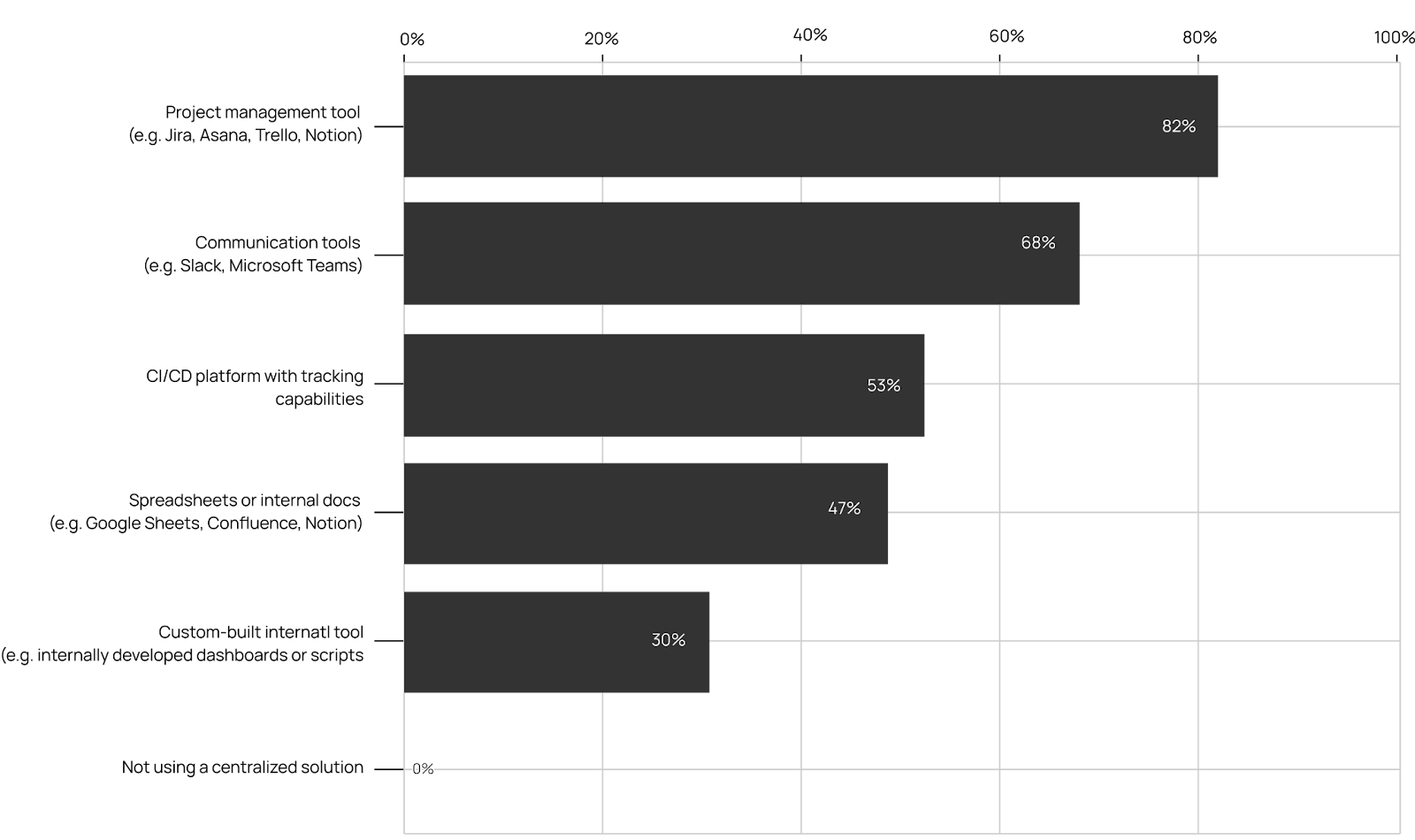
Why? Because they’re general-purpose tools that need manual upkeep to do a hyper-specific job. When someone forgets to update a cell or a Slack thread gets buried, the info goes stale. This creates a gap between the person who knows and everyone else.
A good release dashboard closes that gap and allows stakeholders to quickly see:
- the current release phase
- checklist completion status
- blockers to progress
- build metadata
- app store submission status
- rollout progress
Think of it as the five-second test. If a PM, QA lead, or engineering director can’t grasp the release status in five seconds on the dashboard, your source of truth isn’t clear enough.
This is especially important as teams grow. Early on, one engineer usually carries the full context of every release in their head. That works until it doesn't. As soon as that person is on vacation, or leaves the company, or simply has a bad week, the whole process seizes up. Instead, the best source of truth isn’t an expert on your team; it’s infrastructure available to everyone.
Define ownership, roles, and release cadence
Visibility without ownership is just a dashboard nobody acts on. Every release needs a named owner, and every stage of the release needs someone accountable for moving it forward.
The model that works well for most teams is the release captain. This is a rotating role that carries the responsibility of shepherding the release from branch cut to rollout completion.
This involves:
- owning branch cuts
- coordinating build validation
- updating stakeholders
- making or escalating go/no-go decisions
- monitoring the rollout to 100%
Rotation matters more than it might seem. When one engineer always owns releases, knowledge gets siloed in exactly the way a single source of truth is supposed to prevent. Rotating roles spreads process knowledge throughout the team. This helps prevent burnout from the same person handling the release tasks over and over. Now, anyone on the team can step in when needed. At SoFi, transitioning to a model where new engineers could confidently manage releases with minimal handholding was a significant milestone. This change empowered them to take charge in their roles. Before, every release required someone experienced to walk the new person through it step by step.
Beyond the release captain, it's worth getting explicit about stage-level ownership roles. Who owns code freeze enforcement? Who signs off on QA? Who submits to the app stores? On mature teams, these questions usually have hidden answers. But those answers can't endure team growth, reorganizations, or late-night crises where no one knows who decides.
Whether it’s weekly, biweekly, or another frequency that fits your team’s rhythm, a consistent release cadence forms the foundation for everything. When everyone knows the release branch is cut every Tuesday, planning and coordination become much easier. Uncertainty itself is a coordination tax.



Automate the coordination tax
A huge proportion of coordination work in mobile releases is mechanical:
- reminding people about deadlines,
- bumping version numbers,
- tagging tickets,
- generating changelogs,
- posting status updates to Slack, and
- submitting builds to TestFlight.
Every manual step can lead to mistakes. Things may get dropped, delayed, or done inconsistently. Visibility gets foggier with each misstep, especially when speed increases.
An understandable urge is to automate as much of the release process (and its reporting) as possible. Unfortunately, this often doesn’t actually ease the pain. Seventy-five percent of teams regularly invest in automation and scripting for their release processes to fix these issues. However, these teams still report ongoing challenges with wasted time, high incident rates, and unpredictability.
The reason is what the report calls the automation paradox. Most teams have improved their CI/CD pipelines and build scripts. However, these tools handle specific tasks and don’t unify the release workflow. Engineers are still manually bridging gaps in a fragmented toolchain. They jump between Jira, Slack, CI dashboards, App Store Connect, and spreadsheets. This juggling is needed to fully understand what's happening with each release. The tools are automated, but the coordination between the tools is not.
More automation isn’t the goal here, integration automation is. This means steps trigger automatically as the release moves through stages. The right people get notified in the right channels, at the right time. Information flows through your toolchain without needing manual relays. When a build passes QA, the next steps should kick off without someone manually triggering them. When a submission gets rejected, the right people should be notified right away. No one should need to check a dashboard or send a Slack message.
Instrument your rollouts with release health metrics
Visibility doesn't end at app store submission. The rollout phase is crucial for release coordination and you need real-time signals to decide if you should continue, pause, or roll back. Without health metrics, you’re flying blind at the most critical stage.
Four categories of metrics matter here:
- Stability covers crash-free user rates, crash-free session rates, and out-of-memory crashes.
- Performance covers app startup time, network latency, and ANR rates.
- User behavior covers regressions in key flows such as signups, purchases, and core engagement metrics.
- Store signals cover app store rating trends and review sentiment.
The key is not just having these metrics, but surfacing them in the same place as your release status. When health metrics are displayed alongside release progress, engineering managers and product leads can see the signals clearly. This arrangement makes diagnosing problems easier. It also helps them decide whether to pause or accelerate the process.
You’re not cross-referencing five tabs to determine if a crash spike correlates with a specific build, a late cherry-pick, or a rollout threshold that you just crossed. Good release tools cut down the time from "something's wrong" to "we know what's wrong and who's fixing it." They provide visibility when it counts.
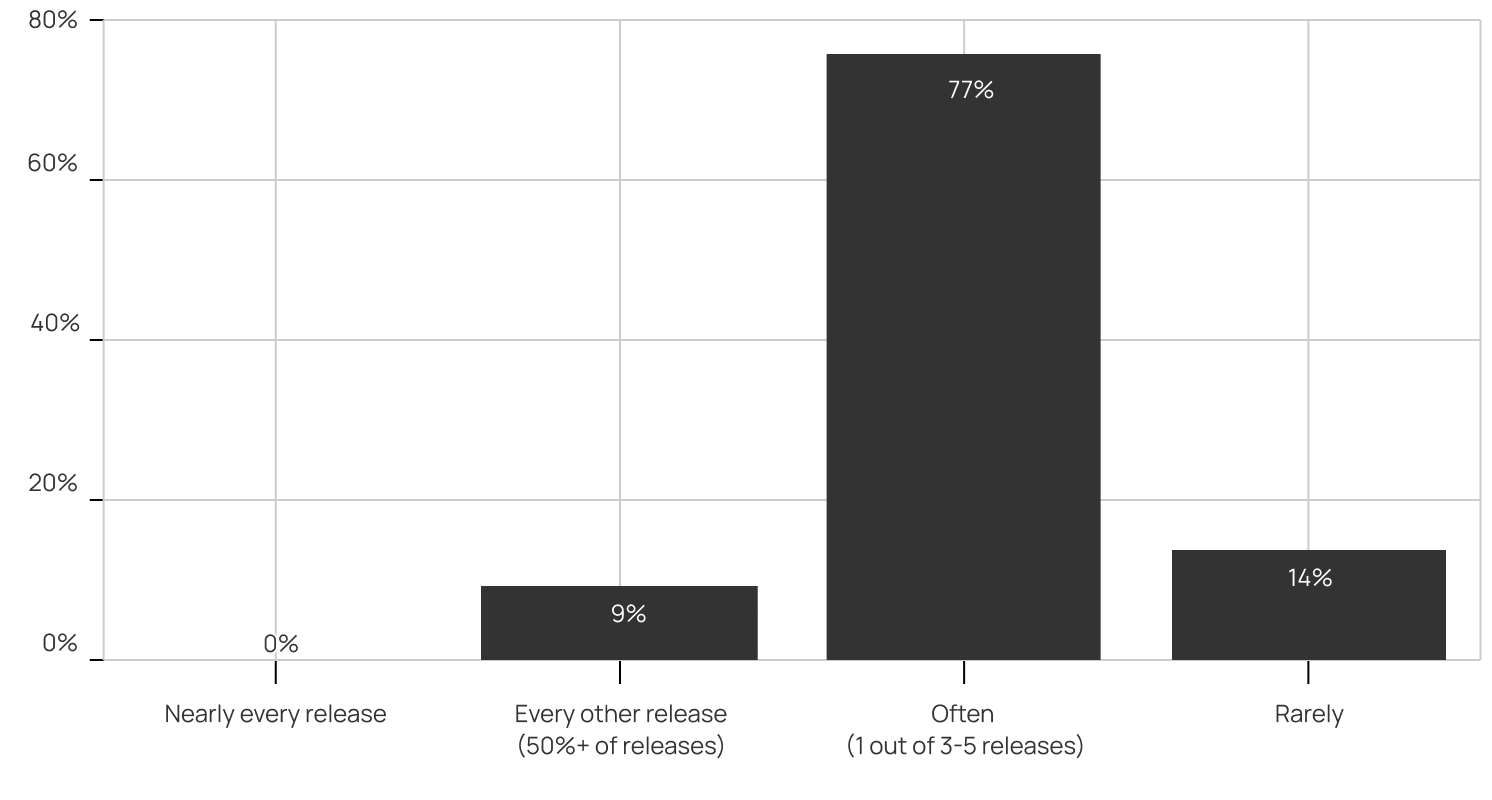
More than 75% of mobile teams face issues needing hotfixes about every fourth release, based on our data. That's a predictable disruption cycle, which means most of this pain isn't unavoidable, it's unmitigated. Better visibility, health-gated rollout controls, and faster triage can turn midnight emergencies into daytime issues. The team can then handle these situations with confidence, not panic.
Building releases that are boring (in the best way)
If you're a senior engineering manager focusing more on release status than product strategy, working harder on the current process won't help. It's to build in visibility that makes coordination easy to track and manage.
That means a single source of truth that any stakeholder can read in five seconds. It means clear ownership at every stage, with rotation that distributes knowledge across the team. It means automation that connects your toolchain rather than adding more tools to juggle. It means health metrics that surface the rollout signal your whole team needs to make decisions with confidence. And, finally, it means documentation and processes that hold up as the team grows, not just today.
The goal is releases that are boring. So routine and well-instrumented that they barely need active coordination. That's not a low bar. It's the highest one.
See how Runway delivers better visibility for your whole team with one shared, unified view → Explore the sandbox
FAQ
What is the biggest obstacle to visibility in a mobile release process?
The biggest obstacle is fragmented information. Release status information is often scattered across Jira tickets, Slack threads, spreadsheets, and individual engineers' heads. When there's no centralized, always-current view of where a release stands, stakeholders and engineers can't get the full picture without pinging someone directly. The fix is a dashboard that acts as a single source of truth to surface phase, blockers, build metadata, app store submission status, and rollout progress in one place.
How do you improve visibility and coordination across a mobile release process?
You improve visibility and coordination across your mobile release process by establishing a single source of truth for release status, defining clear ownership at every stage, automating routine handoffs and notifications, and instrumenting your rollouts with health metrics the whole team can see. The goal is moving from scattered, tribal-knowledge-driven releases to a structured workflow where every stakeholder–engineering to QA to product to leadership–can see exactly where things stand without having to ask.
What release health metrics should you monitor during a mobile app rollout?
The four categories to monitor during a staged rollout are stability (crash-free user rate, crash-free session rate, out-of-memory crashes), performance (app startup time, network latency, ANR rates), user behavior (regressions in key flows like signups or purchases), and store signals (rating trends, review sentiment). These metrics should be visible to the whole team alongside release status (not siloed in a monitoring tool only the on-call engineer checks) so decisions about pausing or accelerating the rollout don't bottleneck on one person.